
Scenarios
Test the decision before you make it
Not a model of an average biotech. Cambrian reads your milestones, sites, batches, budgets and dossier, and shows what a decision does to them as ranges you can defend, with the assumptions written down.
Engines
Seven engines, one contract
Engines are pure functions of the twin, the assumptions and a seed. They never read the clock, the database or the network, so a run reproduces exactly and every forecast names the observable that resolves it.
| Engine | Model | Headline outputs |
|---|---|---|
| Timeline | Dependency graph over playbook steps, tasks, milestones and submissions; slip distributions propagated in order | Completion date per milestone, on-time probability, critical path frequency |
| Runway | Monthly cash with burn drift, milestone-driven costs, grants with award probability and a planned raise | Months of runway, cash-out date, cash at 12 and 24 months, funded probability per milestone |
| Enrollment | Gamma-Poisson site model with startup times, added sites, competing trials, dropout and screen failure | Last patient in, readout, months to target, evaluable N |
| Statistical design | Closed-form sample size and power for continuous, binary and time-to-event endpoints; placebo erosion; assurance | Required N, power at planned N, probability of success, minimal detectable effect |
| Supply | Monthly stock by batch with expiry, demand from enrollment, reorder policy, yield, failure and lead times | Stockout probability, first stockout month, expired units, batches ordered |
| Regulatory pathway | 505(b)(1), 505(b)(2), IDE, EU CTA and 510(k) templates with meeting lead times, dossier completion, statutory clocks and hold branches | Submitted date, study-may-proceed date, hold probability, on-time probability |
| Outcome priors | Elicited effect, adverse event and adherence priors propagated through the design to a readout | Positive readout probability, safety-stop probability, observed effect |
Workflow
One durable workflow per experiment
Steps are journaled. A crashed step resumes where it stopped and nothing runs twice. Without a model key the workflow still completes with catalog and record-derived assumptions.
- 01
Snapshot
The twin is frozen into a content-hashed snapshot. Identical states reuse it, so runs reproduce bit for bit.
- 02
Evidence and priors
Connectors pull comparable trials, papers and adverse event data from ClinicalTrials.gov, PubMed and openFDA. Elicitation strategies produce priors with a confidence label and citations.
- 03
Scenarios
Decision variables expand into candidate scenarios: more sites, a later raise, a different pathway or endpoint, a shifted batch.
- 04
Engines
Each engine runs per scenario from the same seed and horizon. Every number is a distribution summary or a probability.
- 05
Ranking and panel
Scenarios are ranked against constraints. Role personas, and the agency reviewer in a war game, return concerns and questions.
- 06
Report
A credibility record and a report are written into the Data Room as a versioned, signable document.
Credibility
Results state what they rest on
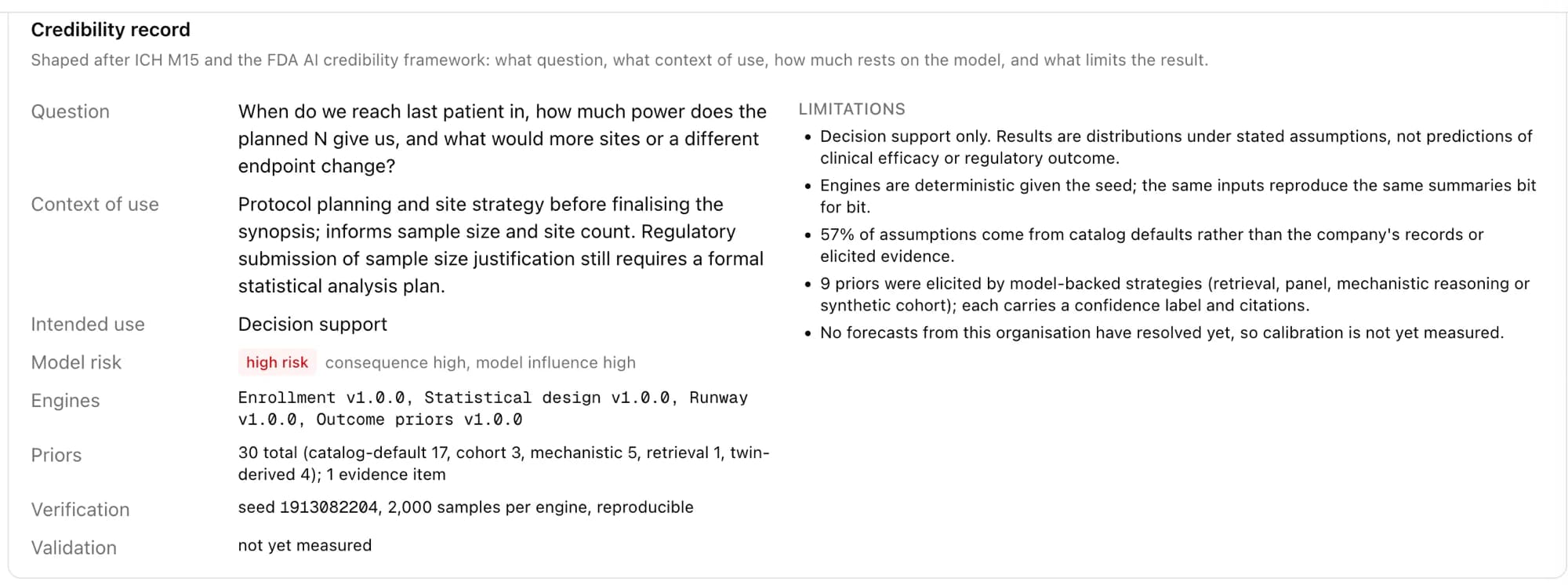
Every experiment carries a credibility record shaped after ICH M15 and the FDA AI credibility framework: question of interest, context of use, decision consequence, model influence, model risk, engines and versions, prior provenance, verification and validation, limitations.
The platform never claims to predict clinical efficacy or regulatory approval, and the interface has no place to show a bare point estimate of either.
Learning loop
Reality scores the platform
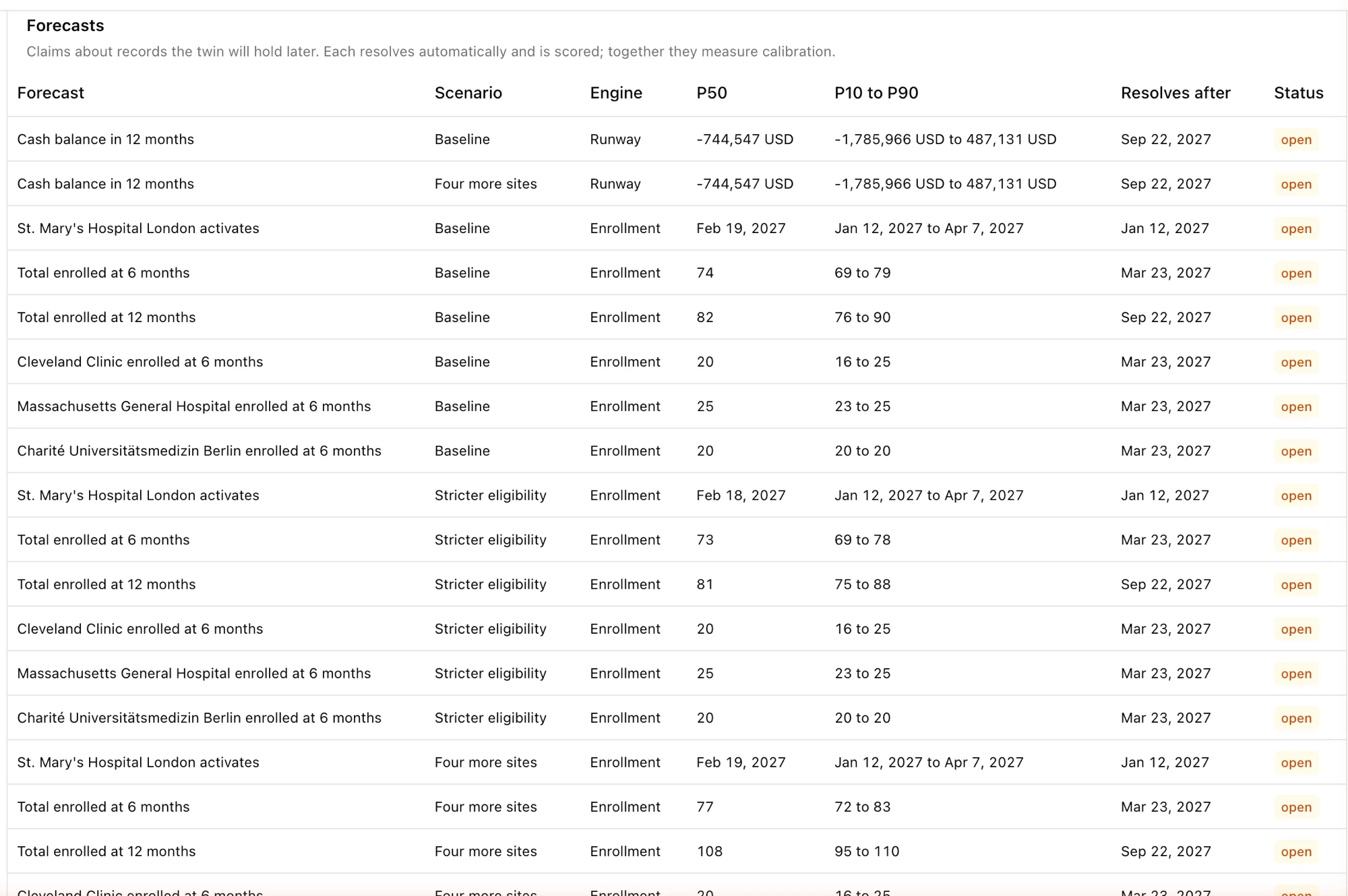
Each run emits forecasts about milestone dates, site activations, enrolled counts, batch depletion and the 12-month cash balance. A nightly resolver reads the live records, scores them (CRPS, Brier, 80% interval coverage, bias in days) and feeds the measured bias back into the engines. A drift detector re-runs the stress test when records move and files risks for critical findings.
In the product
What an experiment looks like
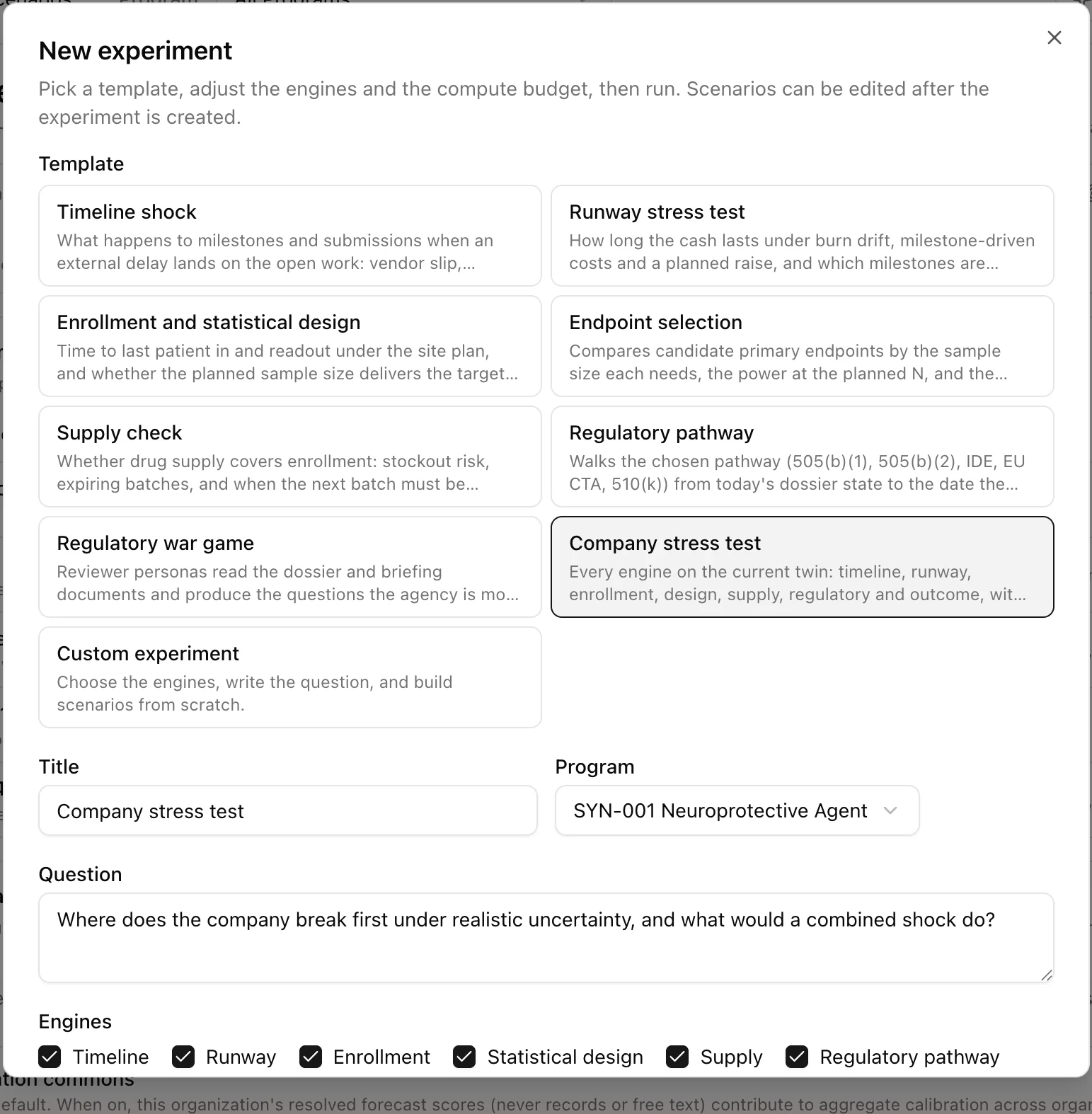
Start from a template
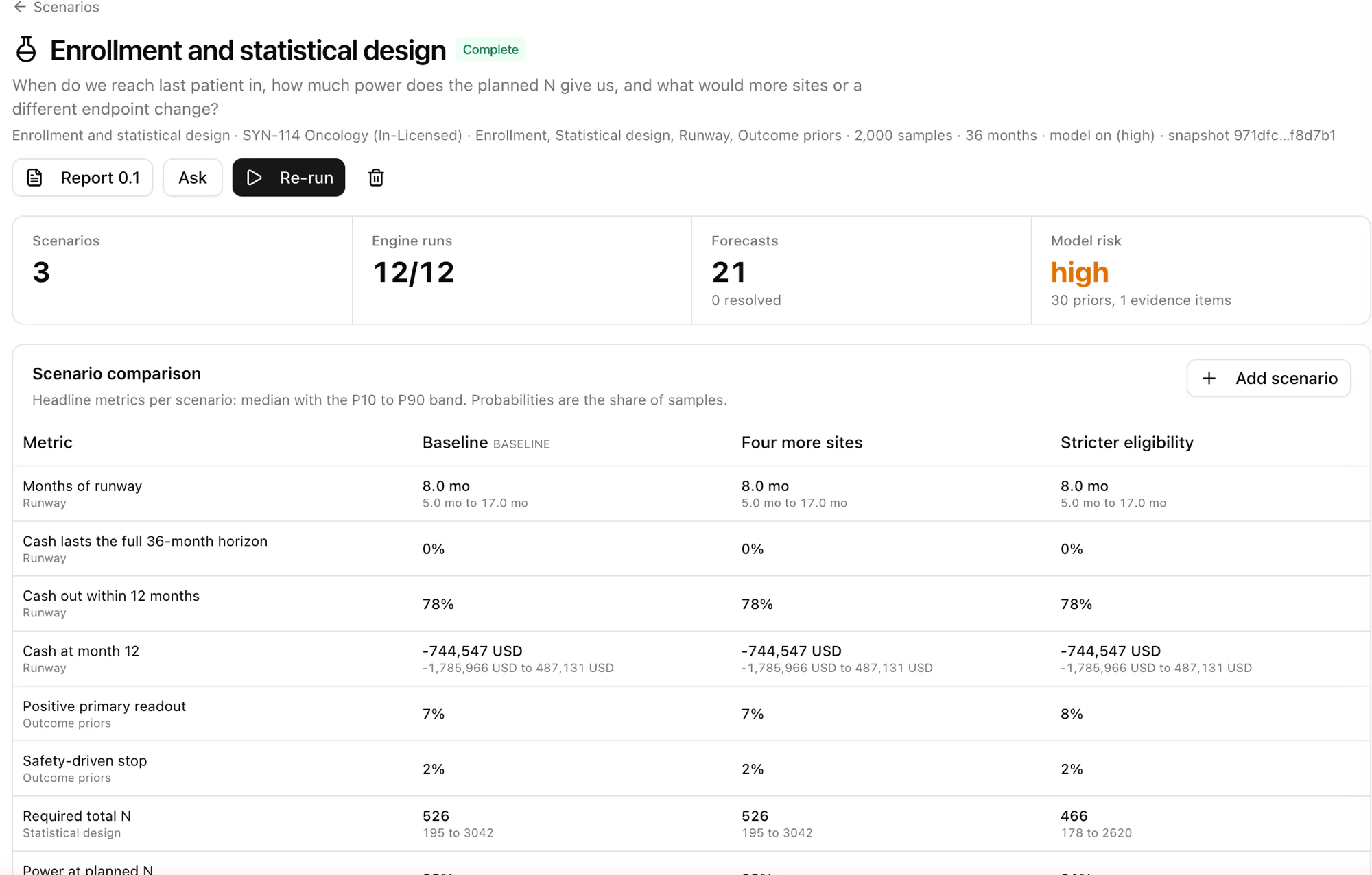
Timeline shock, runway stress, enrollment and design, endpoint selection, supply check, regulatory pathway, war game or a company stress test.
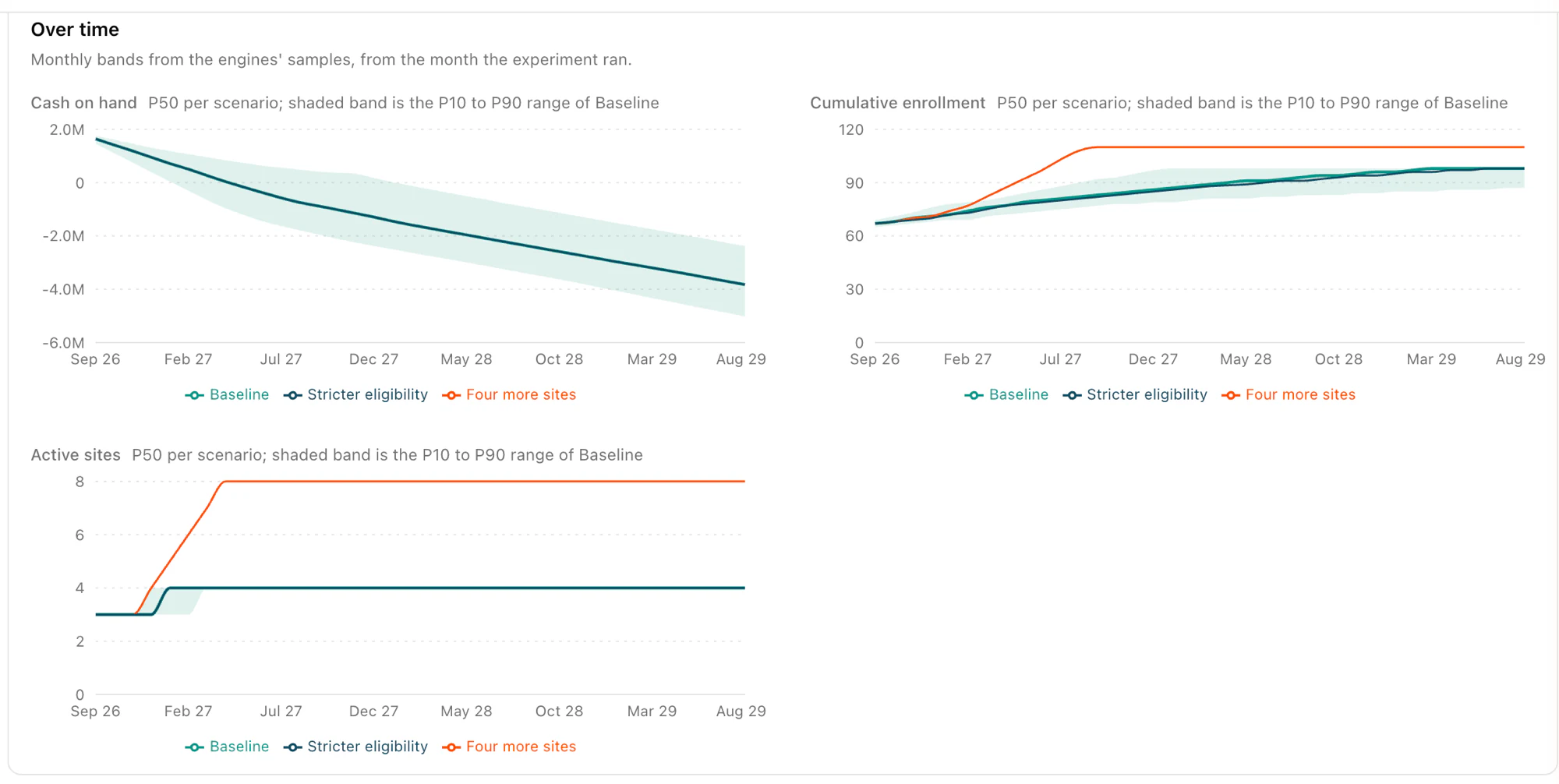
Bands, not points
Every series shows the median per scenario with the P10 to P90 band of the baseline.
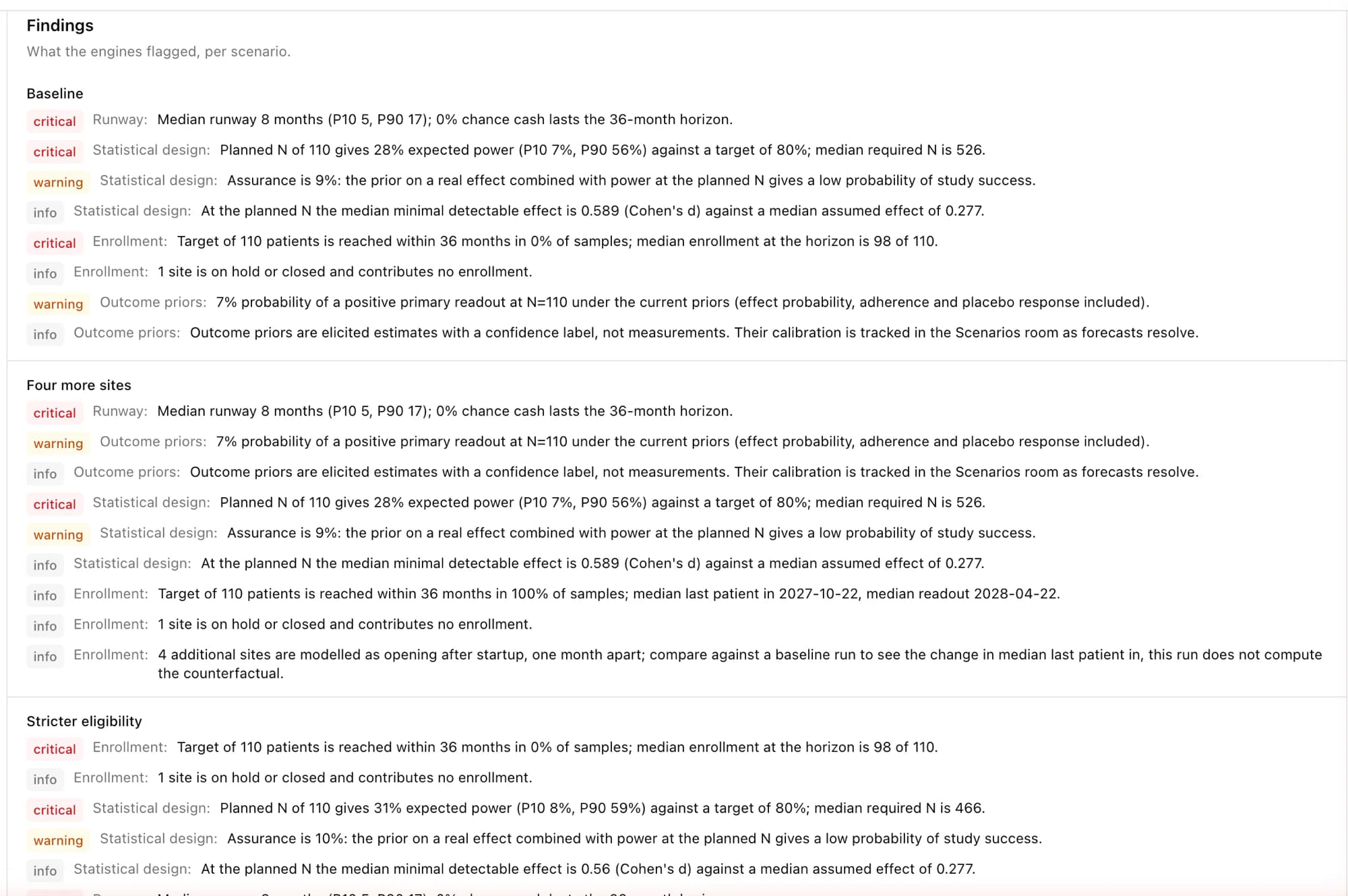
Findings with severity
What each engine flagged, per scenario, with the run that produced it.
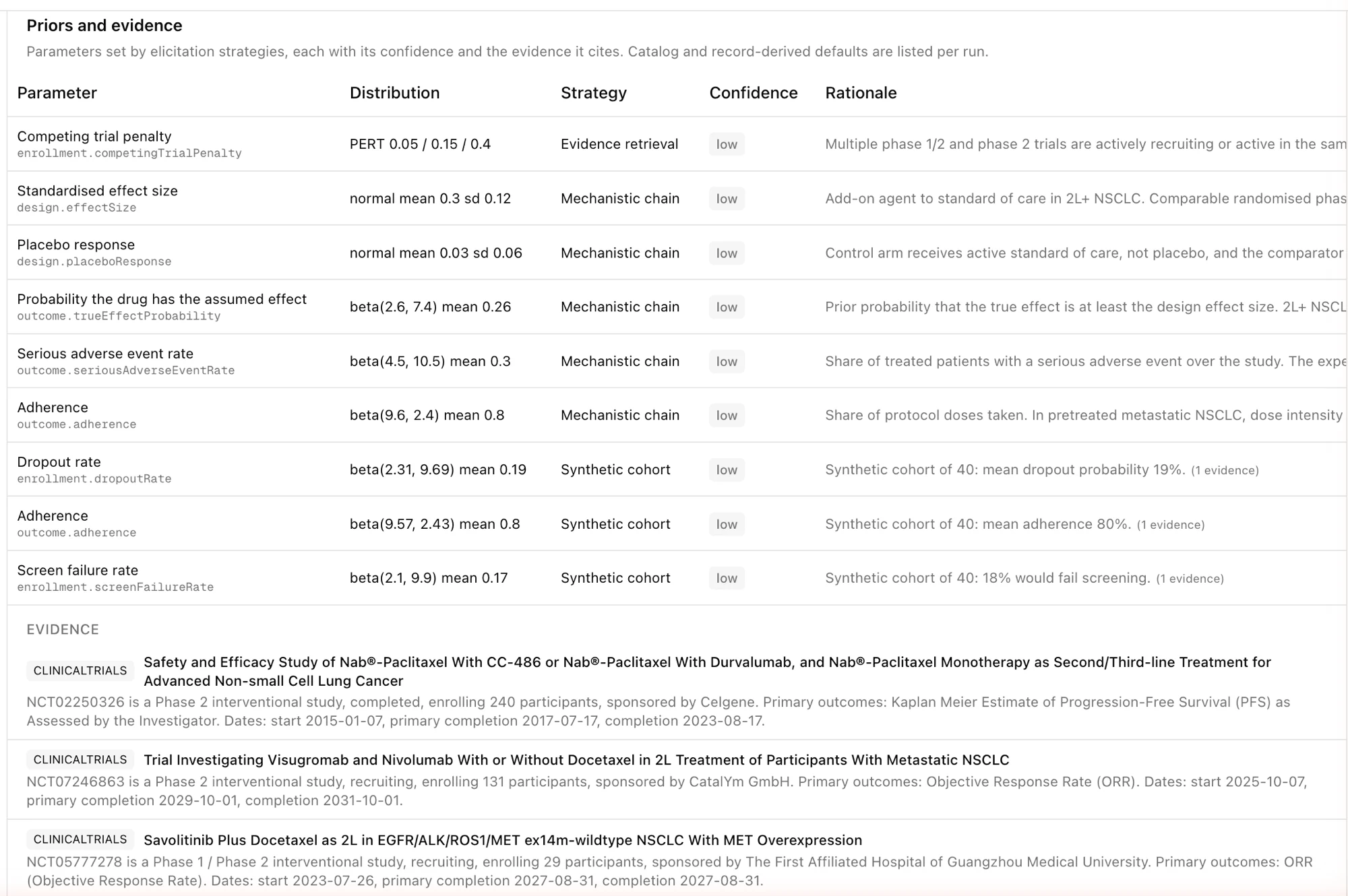
Priors with their evidence
Each parameter names the strategy that set it, its confidence and the trials or papers it cites.
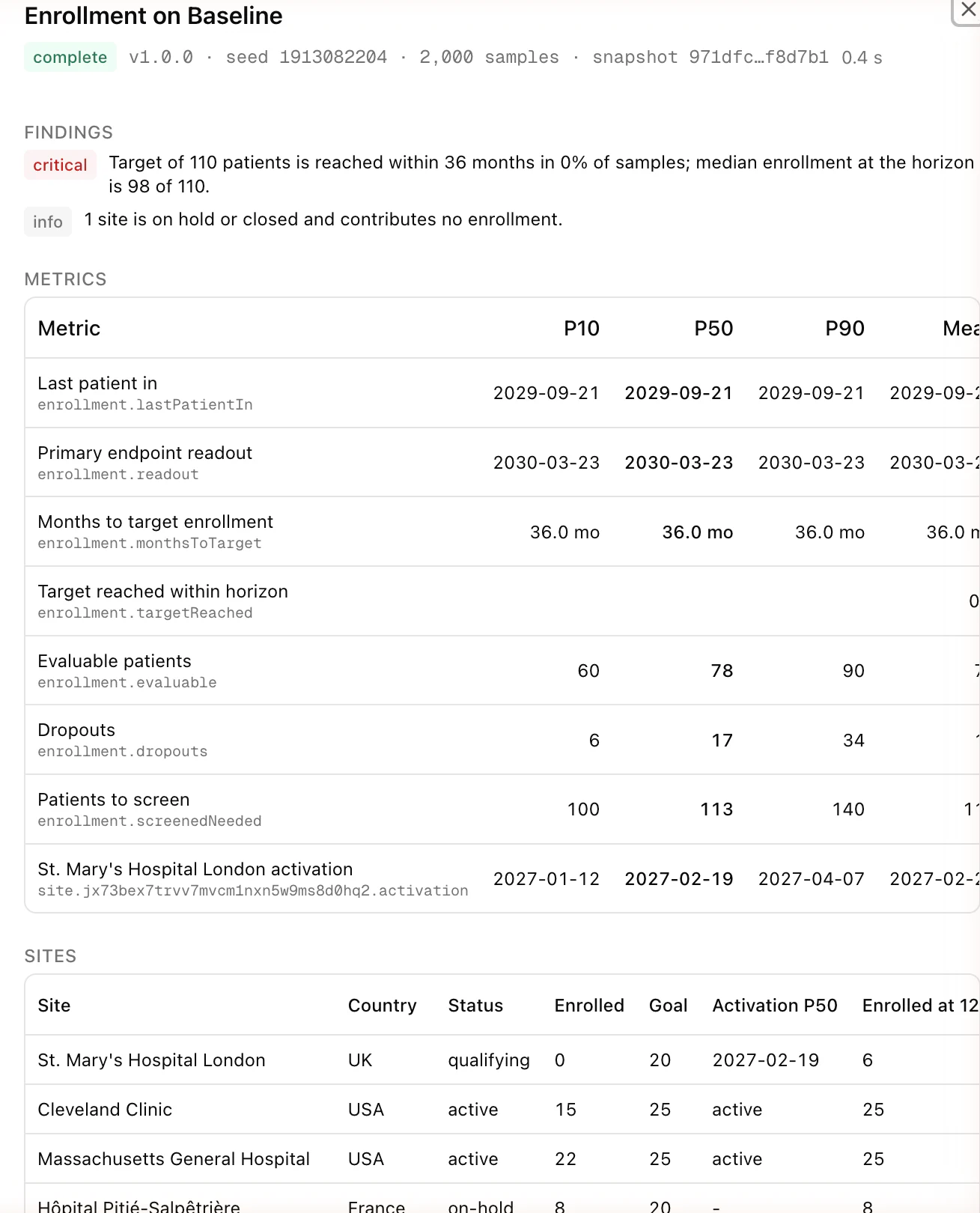
Every run inspectable
Metrics with P10, P50, P90 and mean, per-site tables, and the exact assumptions the engine saw.
Forecasts that resolve
Claims about records the twin will hold later, scored automatically when they do.
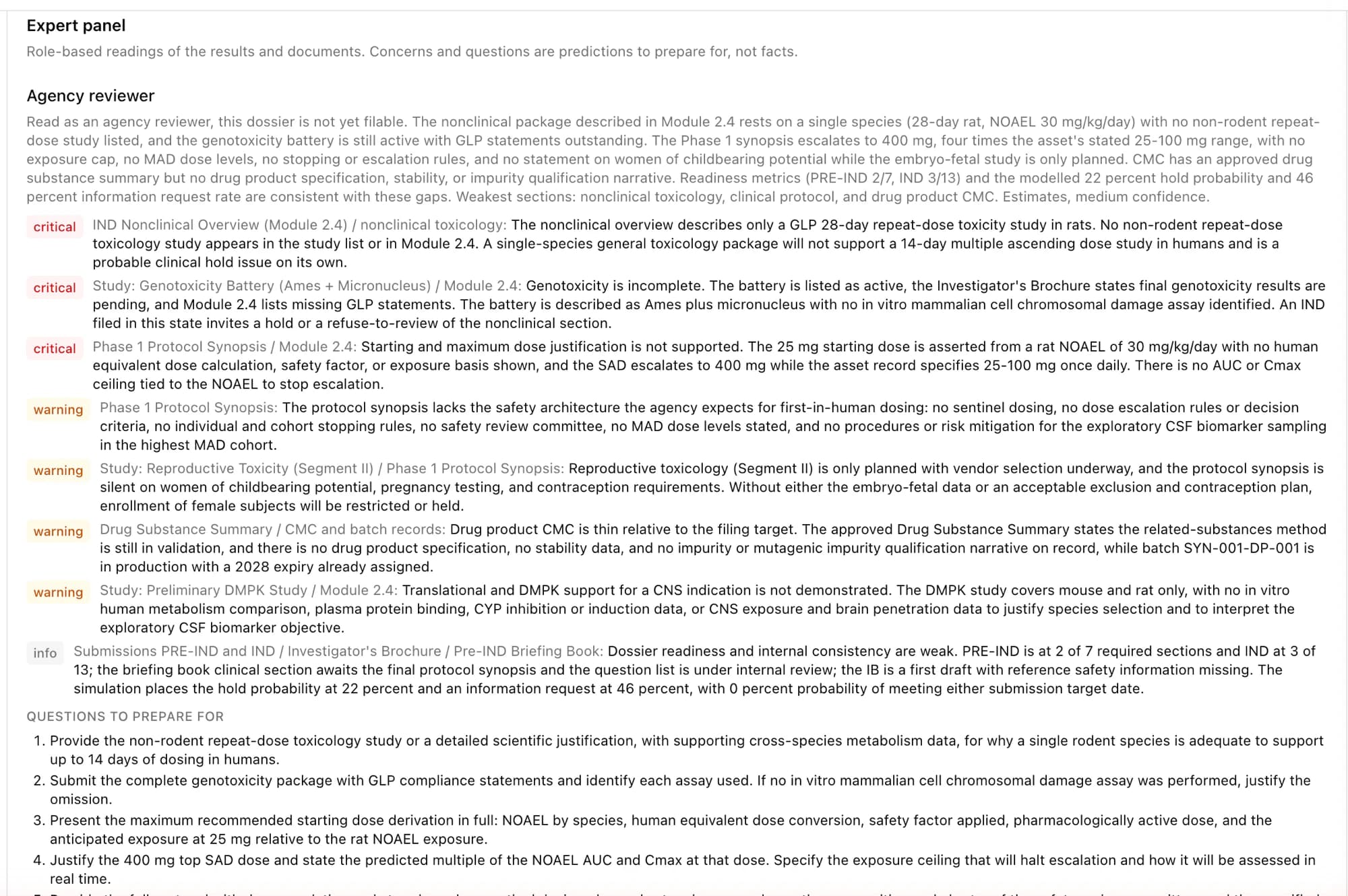
Regulatory war game
An agency reviewer persona reads the dossier documents and returns the questions to prepare for.
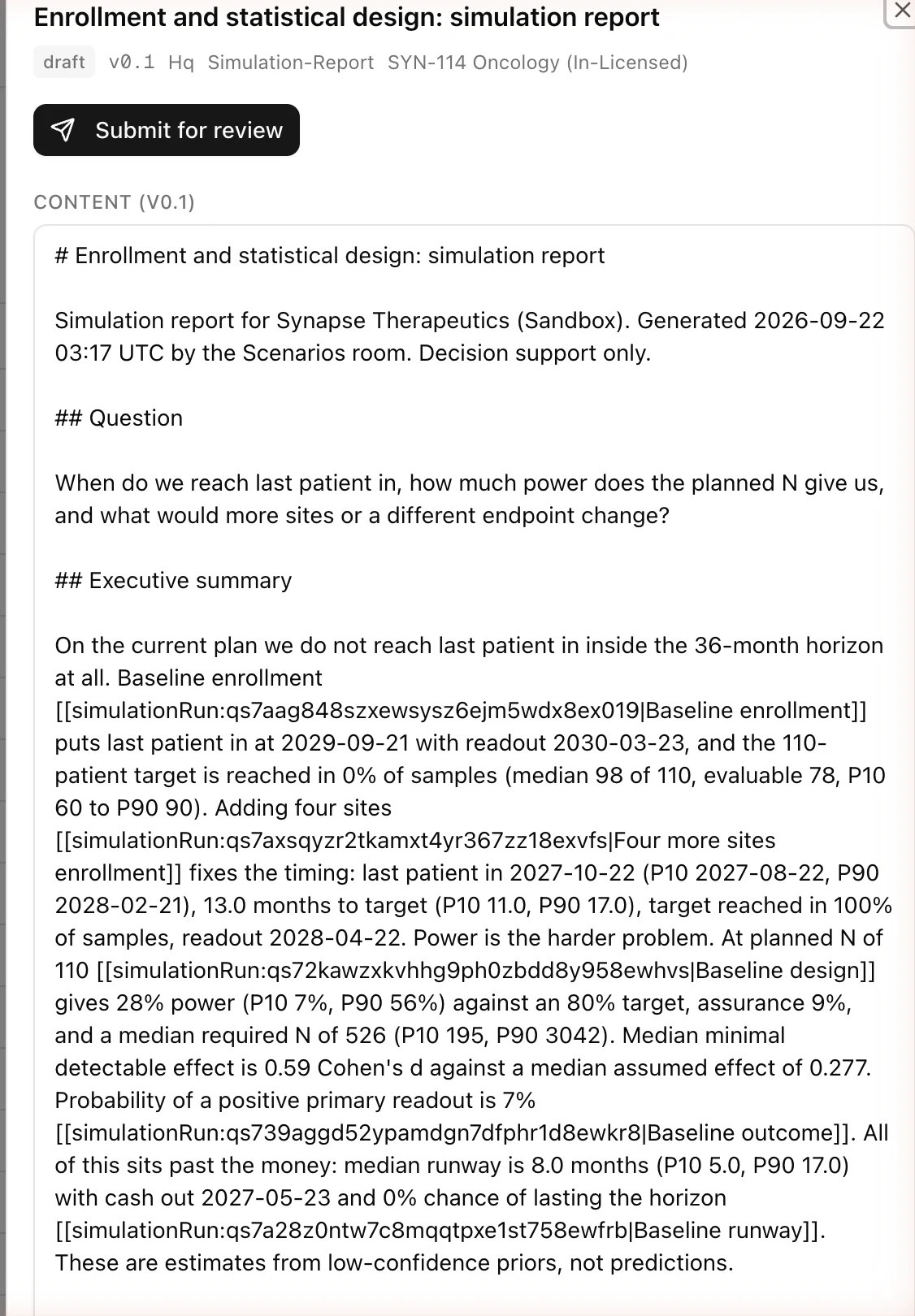
Reports in the Data Room
Versioned, reviewable and signable like every other document.
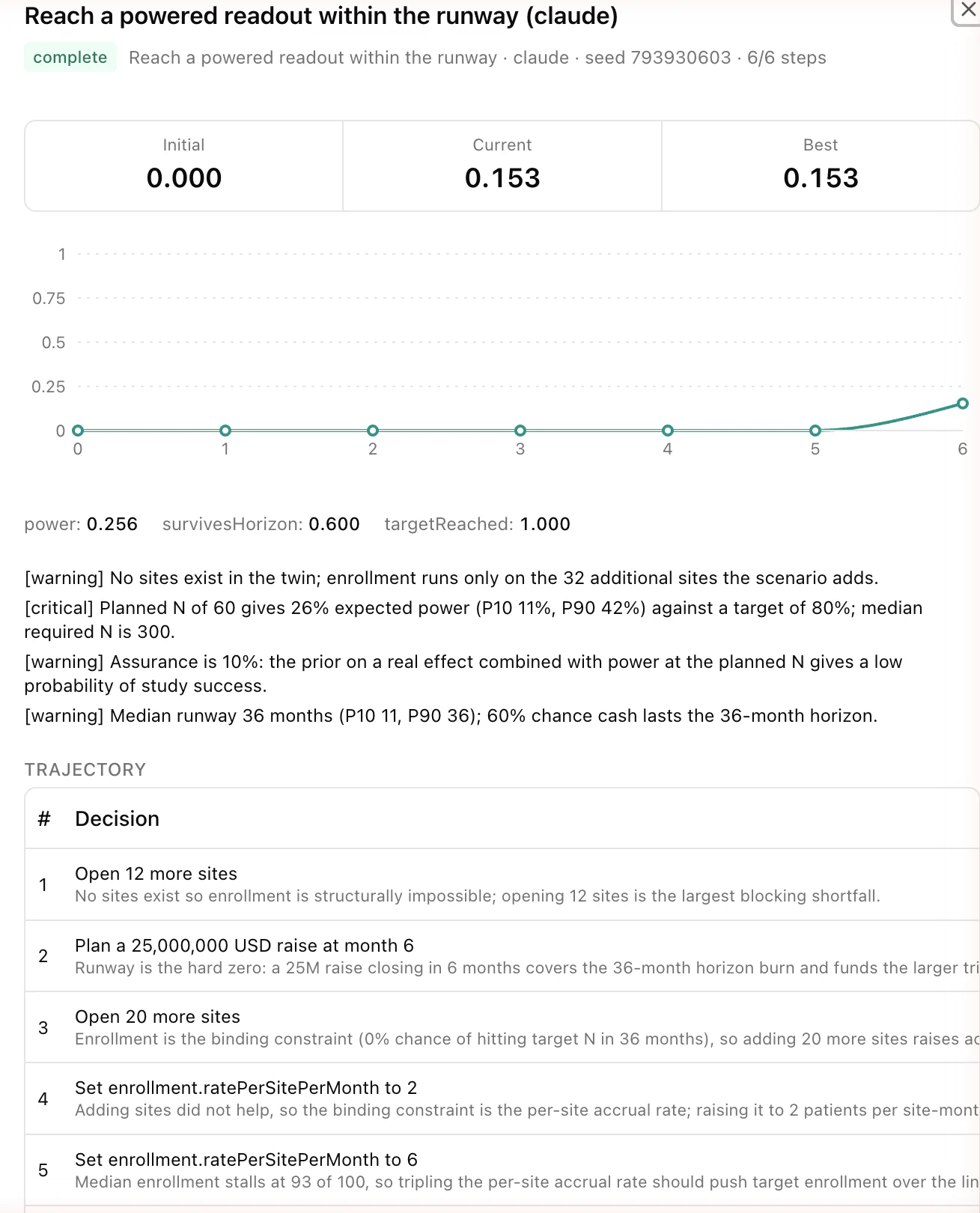
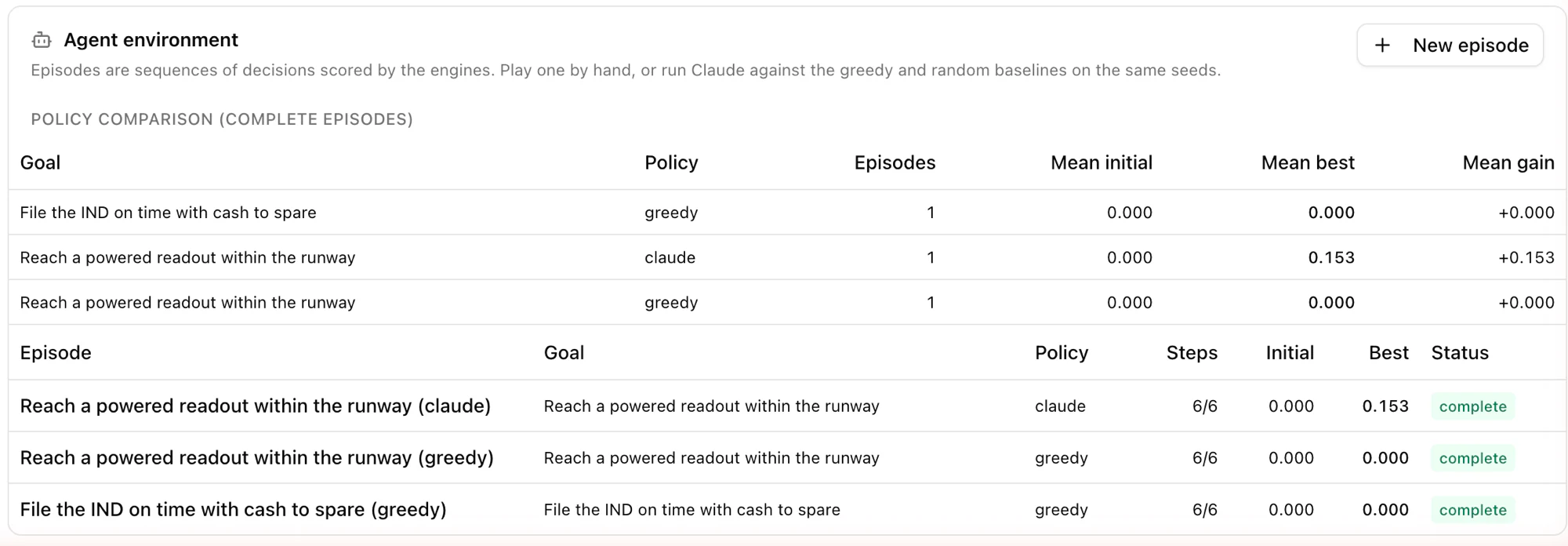
Agent environment
Episodes of typed decisions on a snapshot, scored by the engines. Play by hand or benchmark Claude against greedy and random policies.
See it on your program
A demo runs on a sandbox company first, then on your own records. Bring the decision you are weighing right now and we will simulate it live.